

Most business owners can feel when their company is not growing the way it should.
Sales are coming in. Work is getting done. Things are moving. But the results still do not match the effort.
There’s a disconnect — a sense that something beneath the surface is holding the business back.
These are often the hidden factors that affect business growth, and they’re almost never the ones owners notice first.
According to the latest data from the U.S. Bureau of Labor Statistics, nearly half of all businesses fail within five years. Commerce Institute
The Problems You Can See Are Real — But May Be Only the Symptoms
Business owners are deeply aware of the day-to-day challenges in their companies:
- inconsistent sales
- unpredictable cash flow
- uneven marketing performance
- operational inefficiencies
- staffing struggles
- pressure building on the owner to keep things moving
These are real problems. But the truth is:
The problems you see persist because of deeper, hidden factors that affect business growth.
Marketing problems often trace back to deeper structural issues, not the marketing itself.
Sales inconsistency often comes from weaknesses in other areas.
Turnover rarely happens “just because of hiring.”
Profit margin problems are frequently rooted in structure, not sales volume.
Most business frustrations are symptoms of deeper issues owners simply cannot see from inside their day-to-day responsibilities.
The 9 Vital Areas Every Business Depends On
Every company operates through these nine essential functions. When they are strong, the business grows. When even one is weak, the entire organization feels it. Here are the 9 vital areas every business depends on.
- Executive — leadership direction and clarity
- Organization — structure, roles, and communication
- Repeat Sales — follow-through, consistent activity, and predictable customer return flow
- Finance — margins, cash flow stability, reserves, and planning
- Operations — workflow, delivery quality, and efficiency
- Quality Assurance — standards, oversight, and accountability
- New Sales — lead generation, outreach, prospecting, and expanding your customer base
- Stress — the health of the organization, shown by steady workload flow, manageable pressure, and the absence of bottlenecks.
- Policy (Fundamental Principles) guidelines, expectations, and operating standards
When you view the business through these nine functions, hidden weak spots become clear — often for the first time.
Why Hidden Weaknesses Are So Difficult to Spot
Owners naturally focus on what is urgent: sales, staffing, operations, customer issues.
But hidden weaknesses stay hidden because:
- you are too close to daily operations to see them objectively
- systems that worked years ago no longer fit the current size
- stress becomes “normal,” even when it is damaging
- strong areas compensate for weaker ones
- the business evolved faster than its structure
- no one evaluates all eight functions at the same time
A business can look busy on the surface yet struggle beneath it — just like a building with cracks in its foundation.
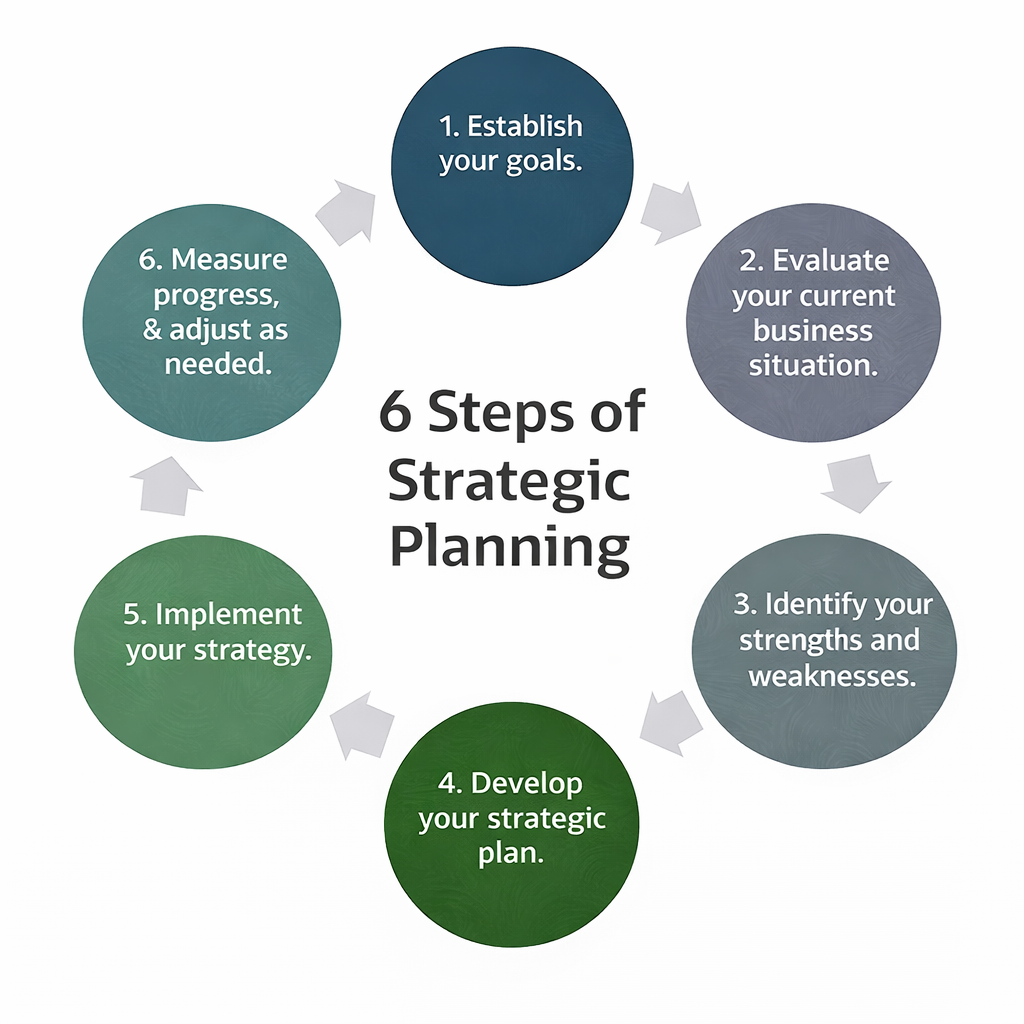
Your Basic Strategic Planning Steps
Below is the 6-step process we use to evaluate and strengthen those areas so you can achieve your goals.
When business owners finally evaluate their company across all of the vital functions, patterns emerge immediately:
- strengths become obvious
- weak points stand out
- recurring frustrations suddenly make sense
- growth barriers reveal themselves
- and priorities become clear
Even small improvements in the right functions can create significant gains across the whole organization.
This is where real growth begins.
If you’re curious which hidden factors that affect business growth may be limiting your progress, you can take the 100-Question Business Analysis. It is free and you will discover where your strengths are — and which structural issues may be holding the business back. Start your Free Business Analysis now.